
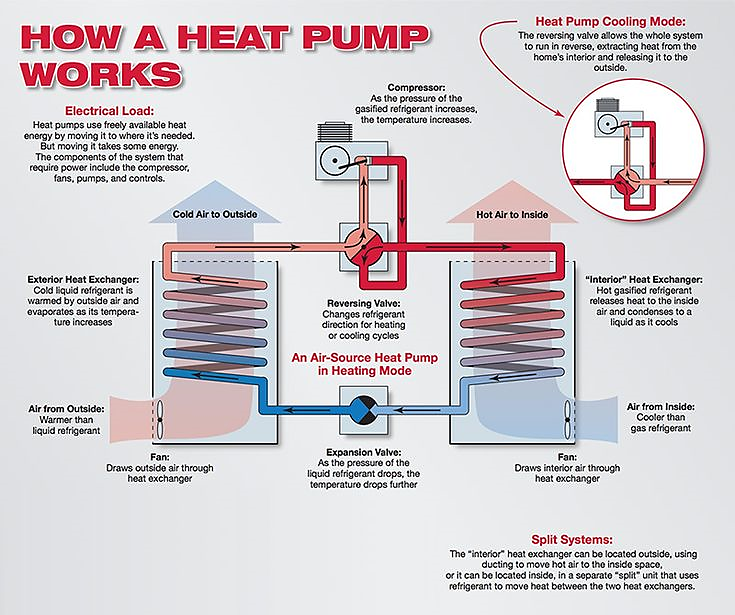
What is a heat pump and how does it work?


A heat pump is an electrical device that extracts heat from one place and transfers it to another. The heat pump is not a new technology; it has been used in Canada and around the world for decades. Refrigerators and air conditioners are both common examples of heat pumps.


Heat pumps transfer heat by circulating a substance called a refrigerant through a cycle of alternating evaporation and condensation. A compressor pumps the refrigerant between two heat exchanger coils. In one coil, the refrigerant is evaporated at low pressure and absorbs heat from its surroundings. The refrigerant is then compressed en route to the other coil, where it condenses at high pressure. At this point, it releases the heat it absorbed earlier in the cycle.


Refrigerators and air conditioners are both examples of heat pumps operating only in the cooling mode. A refrigerator is essentially an insulated box with a heat pump system connected to it. The evaporator coil is located inside the box, usually in the freezer compartment. Heat is absorbed from this location and transferred outside, usually behind or underneath the unit where the condenser coil is located. Similarly, an air conditioner transfers heat from inside a house to the outdoors.


The heat pump cycle is fully reversible, and heat pumps can provide year-round climate control for your home-heating in winter and cooling and dehumidifying in summer. Since the ground and air outside always contain some heat, a heat pump can supply warmth to a house even on cold winter days. In fact, air at 18°C contains about 85% of the heat it contained at 21°C.


Vancouver Island has one of the highest Heating Seasonal Performance Factor (H.S.P.F.) in Canada, which translates into this area providing the most economical environment in Canada for heat pump use.

EFFICIENCY

At 10°C, the coefficient of performance (COP) forHeat pump graph air-source heat pumps is typically about three. This means that 3 kWh of heat are transferred for every kWh of electricity supplied to the heat pump.

The COP decreases with temperature because it is more difficult to extract heat from cooler air. However, the heat pump compares favorably with electric resistance heating (COP of 1.0) even when the temperature falls to -15°C.


So... what is a heat pump?


It's a financially sound investment in your energy future.